
Cheap and Reliable LLM API Platforms: A 4-Step Buyer's Guide for Teams
If the last two years of AI infrastructure were a new industrial revolution, the "LLM API platform" is its power grid — invisible day-to-day, yet it decides your cost, reliability, and delivery speed. For many teams the first step of an AI project isn't training a model; it's grinding through three chores: registering separate OpenAI / Google / Anthropic accounts, adapting 3–5 SDKs, and reconciling several invoices. Inconsistent interfaces, payment friction, and unpredictable cost are exactly why "cheap and reliable LLM API platform" became a search trend.
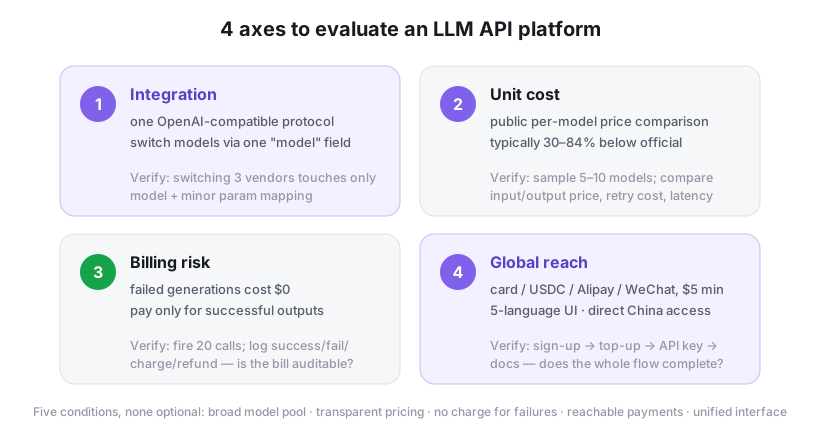
But choosing a platform was never about "more models is better." It's about hitting four metrics at once: integration speed, unit cost, billing risk, and global reach. Below is a practical 4-step checklist, using an aggregator like 97AI.PRO as the running example — it isn't about a single model's raw ability, but about collapsing 150+ top models into one API, one key, one balance. The code runs against its real OpenAI-compatible endpoint; just add your key.
Step 1 — Does "unified access" really mean one codebase, many models?
Ignore the marketing; measure how much you must change to switch models. A truly unified platform lets you change one model field — no re-auth, no new SDK, no rewired callbacks.
curl https://97ai.97claude.com/v1/chat/completions \
  -H "Authorization: Bearer <YOUR_API_KEY>" \
  -H "Content-Type: application/json" \
  -d '{
    "model": "gpt-5-6-terra",
    "messages": [{"role": "user", "content": "Summarize this report."}]
  }'
Switch to Claude by changing "model" to "claude-opus-4-8" — nothing else moves. Because the endpoint is OpenAI-compatible, any OpenAI SDK works after swapping base_url.
This suits three kinds of teams especially: A/B testing teams, cross-border SaaS teams, and workflow teams that run text + image + video models in one pipeline.
• Verify: more models ≠ identical parameter support. Test advanced features (streaming, function calling, vision) per model. • How: switch three vendors' models and confirm the diff touches only model plus minor parameter mapping.
Step 2 — Is pricing transparent, and actually below official?
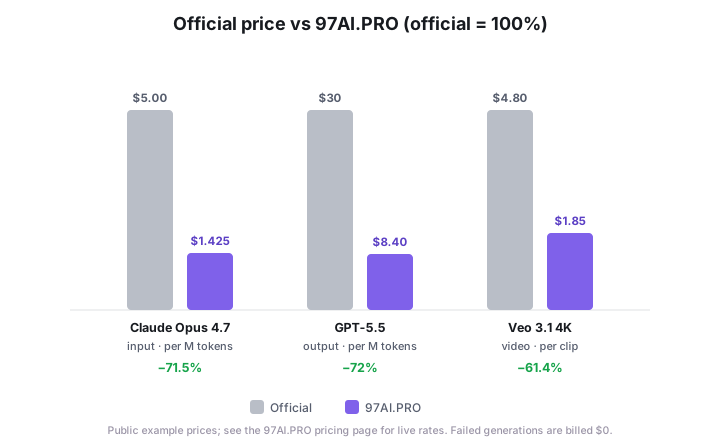
Everyone claims "cheaper." What matters: is pricing public, comparable side-by-side, and granular per model? 97AI.PRO lists each model's own price, the official price, and the discount right on the page — better for procurement than platforms that hide quotes behind a login.
Public example prices (confirm live on the pricing page):
| Model | Official | 97AI.PRO | Savings |
|---|---|---|---|
| GPT-5.5 · output | $30 / M tokens | $8.40 / M | ~72% |
| Claude Opus 4.7 · input | $5.00 / M tokens | $1.425 / M | ~71.5% |
| Veo 3.1 4K · video | $4.80 / clip | $1.85 / clip | ~61.4% |
The edge isn't just "spend less" — it's predictable budget. A team processing 10M tokens/month sees hundreds to thousands of dollars of difference even at a 30% cut; for batch, tuning, and canary workloads that margin compounds.
• Verify: is low price paid for with higher latency or worse stability? Test it separately. • How: sample 5–10 common models and compare input price, output price, retry cost, and peak latency.
Step 3 — Does the billing model minimize experimentation risk?
In production, "are failed calls billed?" affects real ROI more than the sticker price. In workflow automation, batch generation, and long-chain reasoning, the fear isn't expensive successes — it's paying for failures too. 97AI.PRO's rule is blunt: failed generations cost $0 — you pay only for successful outputs; failures return an error, uncharged.
That matters most during exploration: batch-generating product descriptions, or testing dozens to hundreds of prompt variants, failures (timeouts, content filtering) are inevitable — zero-risk billing cuts wasted spend and lets teams run bold A/B experiments.
• Verify: clear task states and traceable refunds. • How: fire 20 test requests; log success / failure / charge / refund and check the bill is auditable.
Step 4 — Payments and reach often decide "can I even use it?"
An overlooked truth: not every problem is in the code. Many users are blocked at payment — especially in mainland China, LATAM, and Eastern Europe where international cards are restricted. A platform that only takes US cards loses value on the ground no matter how strong its performance.
97AI.PRO accepts credit card, USDC (Arbitrum), Alipay, and WeChat Pay, with a $5 minimum top-up — friendlier for indie devs, small teams, and overseas pilots. Add a 5-language UI (EN/中/ES/DE/JA) and direct access from mainland China without a VPN, and it clearly isn't built for North American developers only. Payment isn't a feature; it's part of the conversion path.
• Verify: is "multilingual" just nav translation? Check that model, docs, and pricing pages have localized bodies and their own URLs. • How: complete sign-up, top-up, API-key creation, and docs — end to end.
Conclusion: five conditions, none optional
So what actually is a "cheap and reliable LLM API platform"? At minimum, five things at once: a broad model pool, transparent public pricing, no charge for failures, reachable payments, and a unified interface. No single one is enough — evaluate them inside the full delivery chain.
On public information, 97AI.PRO reads less like a cheaper model and more like an *infrastructure capability*: not a replacement for every official channel, but higher operational efficiency across multi-model orchestration, cost control, and global payments. Still, benchmark stability, latency, and peak load against your own workload — conclusions differ by use case.
Procurement TL;DR: (1) test interface unification; (2) compare price transparency and the ~30–84% discount band; (3) check billing (failures $0? credits expire?); (4) verify payments and reach. Cheap matters — but stable, transparent, and verifiable is what makes it last. An aggregator like 97AI.PRO at least belongs on the shortlist, evaluated against real workloads.