Claude + GPT via One OpenAI-Compatible API — The 97AI.PRO Guide
TL;DR — Instead of maintaining two SDKs, two keys, and two billing accounts for Anthropic and OpenAI, you can call Claude and GPT through a single OpenAI-compatible endpoint. You switch models by changing one string ("model"), pay roughly 30–84% less than official list prices, and never pay for failed generations. Below is working cURL / Python / Node.js code you can run today.
The problem: "using one model" is a myth in real products
If you build AI features for a living, two things bite you fast:
1. Protocols don't match. Anthropic's Messages API and OpenAI's Chat Completions API differ in fields, auth, and billing. 2. Real apps use several models. Claude is strong at long-context analysis and steady writing; GPT is strong at general generation and tool/function calling; you often want Gemini or Grok on standby too.
The cost of wiring up multiple official APIs isn't just the sticker price — it's the engineering tax: two SDK code paths, two key-management flows, two billing reconciliations, region-locked payment cards, and the quiet cost of failed calls during batch experiments.
The moment your model count grows from 2 → 5 → 10+, that tax scales non-linearly. The fix is an old idea applied to LLMs: put a gateway in front of the providers.
The architecture: one gateway, four layers
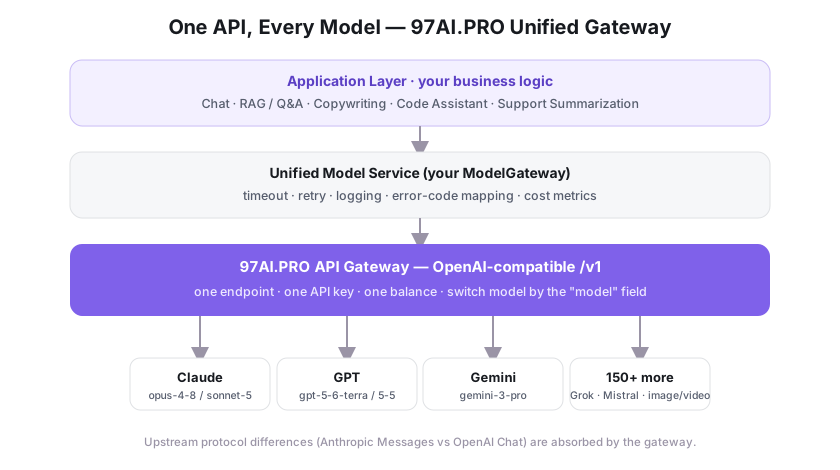
1. Application layer — your business logic (chat, RAG, copywriting, code assistant, support summaries). It depends on *one* calling interface, not on any vendor. 2. Unified model service — a thin ModelGateway you own: timeout, retry, logging, error-code mapping, cost metrics. 3. 97AI.PRO API gateway — one OpenAI-compatible endpoint, one key, one balance. Claude, GPT, Gemini and 150+ models share it. 4. Model providers — Claude / GPT / Gemini / Grok / image & video models behind the gateway. Protocol differences are absorbed here.
The whole trick: switch models by changing one field
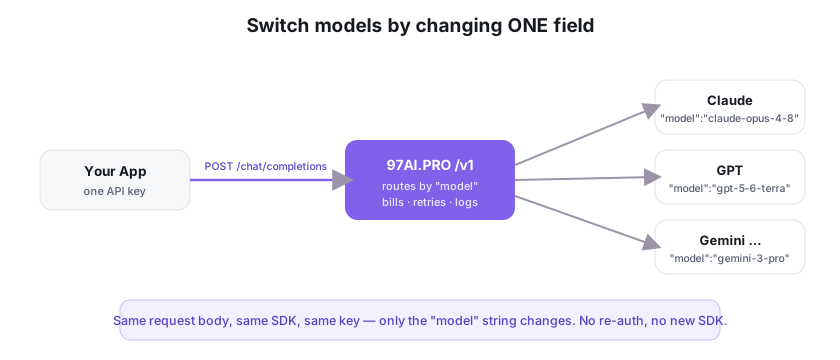
• Base URL: https://97ai.97claude.com/v1 • Auth: Authorization: Bearer <YOUR_API_KEY> • Model switch: change "model". Common choices: • gpt-5-6-terra, gpt-5-5 — general generation, tool calls, code • claude-opus-4-8, claude-sonnet-5 — long-context analysis, robust writing • gemini-3-pro — multimodal, very long context
Because the endpoint is OpenAI-compatible, any OpenAI SDK works unchanged — you only swap the base_url.
Working code (run it as-is, just add your key)
cURL — smoke test
curl https://97ai.97claude.com/v1/chat/completions \
  -H "Authorization: Bearer $YOUR_API_KEY" \
  -H "Content-Type: application/json" \
  -d '{
    "model": "claude-opus-4-8",
    "messages": [{"role": "user", "content": "Explain RAG in three sentences."}]
  }'
Change "model" to "gpt-5-6-terra" to hit GPT instead — nothing else changes.
Python — the official `openai` SDK
# pip install openai   (no anthropic SDK needed)
from openai import OpenAI

client = OpenAI(
    api_key="YOUR_97AI_API_KEY",
    base_url="https://97ai.97claude.com/v1",   # the only change
)

def call(model: str, prompt: str) -> str:
    r = client.chat.completions.create(
        model=model,
        messages=[
            {"role": "system", "content": "You are a helpful assistant."},
            {"role": "user", "content": prompt},
        ],
        temperature=0.7,
        max_tokens=1024,
    )
    return r.choices[0].message.content

# Same code, different vendor — decided by `model`
print(call("gpt-5-6-terra", "Summarize the core goal of this spec."))
print(call("claude-opus-4-8", "Analyze the logical structure of this long text."))
Node.js — the official `openai` package
import OpenAI from "openai";

const client = new OpenAI({
  apiKey: process.env.YOUR_97AI_API_KEY,
  baseURL: "https://97ai.97claude.com/v1",
});

async function call(model, content) {
  const r = await client.chat.completions.create({
    model,
    messages: [
      { role: "system", content: "You are a helpful assistant." },
      { role: "user", content },
    ],
    temperature: 0.7,
    max_tokens: 1024,
  });
  return r.choices[0].message.content;
}

console.log(await call("gpt-5-5", "Write a product blurb."));
console.log(await call("claude-sonnet-5", "Extract the key points from these minutes."));
Streaming (SSE)
stream = client.chat.completions.create(
    model="claude-opus-4-8",
    messages=[{"role": "user", "content": "Write a 300-word product story."}],
    stream=True,
)
for chunk in stream:
    print(chunk.choices[0].delta.content or "", end="", flush=True)
Recommended: a tiny routing layer
Never hardcode model names into business flows. Route by task, so changing strategy is a one-line edit:
MODEL_BY_TASK = {
    "long_context_analysis": "claude-opus-4-8",  # long docs, deep analysis
    "general_generation":    "gpt-5-6-terra",     # generation, tool calls
    "cheap_batch":           "gemini-3-flash",     # high-volume, cost-first
}

def route(task: str) -> str:
    return MODEL_BY_TASK.get(task, "gpt-5-6-terra")
Cost: how much cheaper, exactly?
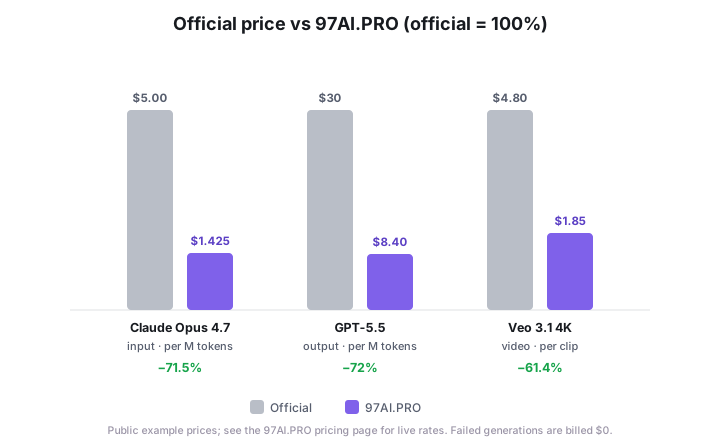
Public example prices (check the pricing page for live rates):
| Item | Official | 97AI.PRO | Savings |
|---|---|---|---|
| Claude Opus 4.7 — input | $5.00 / M tokens | **$1.425 / M** | ~71.5% |
| GPT-5.5 — output | $30 / M tokens | **$8.40 / M** | ~72% |
| Veo 3.1 4K — video | $4.80 / clip | **$1.85 / clip** | ~61.4% |
Two structural cost wins beyond the sticker price: failed generations are billed $0 (zero-risk billing — great for batch A/B testing), and everything runs off one balance instead of N reconciliations.
Direct connect vs. self-built multi-vendor vs. unified gateway
| Criteria | Single official API | Self-built multi-vendor | 97AI.PRO unified |
|---|---|---|---|
| Models available | limited to one vendor | as many as you wire up | 150+ |
| Interface consistency | medium | low | high (OpenAI-compatible) |
| Model-switch cost | medium | high | low (change `model`) |
| Failed-call billing | per vendor rules | per vendor rules | **always $0** |
| Payments | usually intl. card only | your problem | card / USDC / Alipay / WeChat |
| Min top-up | varies | varies | **$5** |
| Mainland-China access | vendor-dependent | your problem | direct |
Who should pick what
• Solo devs / small teams — value speed, easy payment, cheap iteration → unified gateway. • Global / cross-border teams — value USDC/Alipay, multilingual UI, flexible switching → unified gateway. • Multi-model product teams — Claude *and* GPT, not either/or → unified gateway beats deep single-vendor lock-in. • Very large enterprises — weigh SLA, audit, compliance, private deployment; aggregation fits efficiency-first work, while extreme custom protocol control may keep some direct connections.
Pitfalls when wiring Claude + GPT
1. Don't hardcode model names — route via config/env (see the routing table). 2. Mind context windows & output style — Claude and GPT differ on detail retention and structured output; pick per task. 3. Standardize errors & retries — handle timeouts, 429 rate limits, 5xx, and context-too-long distinctly. 4. Observe cost — track success rate, latency, daily token spend, and per-task cost. 5. Ship with canary routing — roll a new default model to 5% → 10% → 30% before full switch.
FAQ
Can I use the OpenAI SDK to call Claude? Yes. Point the OpenAI SDK's base_url at https://97ai.97claude.com/v1 and set model to claude-opus-4-8 (or claude-sonnet-5). No Anthropic SDK required.
How do I switch between Claude and GPT? Change the model field only — e.g. claude-opus-4-8 ↔ gpt-5-6-terra. Request body, auth, and SDK stay the same.
Is it really cheaper than official APIs? On public example prices, roughly 30–84% cheaper (e.g. GPT-5.5 output $8.40/M vs $30/M official). Failed generations cost $0.
Do I pay for failed requests? No. Billing is zero-risk — you're only charged for successful outputs.
What payment methods and regions are supported? Credit card, USDC (Arbitrum), Alipay, and WeChat Pay; minimum top-up $5; works from mainland China without a VPN.
How many models are available through one key? 150+ — chat (Claude, GPT, Gemini, Grok, Mistral, Cohere, Kimi) plus image, video, and music models.
Bottom line
The real question isn't "how do I write the request" — it's "how do I fold multi-model capability into one maintainable framework." For a single model, direct connect is fine. But once you're in multi-model, multi-scenario, multi-region-payment, many-experiments territory, a unified gateway pays for itself: one API, one key, one balance in front of 150+ models — cheaper, with failed calls free, global payments, and direct China access.
Sample code runs as-is once you add your API key. In production, follow the OWASP API Security Top 10 (auth, rate-limiting, request validation, auditing), redact sensitive data in logs, and confirm each model's parameter support and live price in the 97AI.PRO docs.