
From Price War to Reliability War: LLM API Platforms Enter the Total-Cost Era
For two years the LLM API market fought a visible price war — a fresh price cut every few weeks, developers happily comparing quotes. But once the per-token price is low enough, a colder question surfaces: what comes after cheap? More and more teams find that what really eats budget and attention isn't "a few dollars more per million tokens" — it's the invisible costs: failed retries, invoice reconciliation, cross-vendor adaptation, blocked payments.
So the center of gravity is shifting: from "who's cheapest" to "whose total delivery cost is lower, steadier, and more verifiable." Call it the total-cost era of LLM API platforms — teams no longer stare at unit price; they run TCO accounting that folds in integration hours, failure waste, operational complexity, and payment reach.
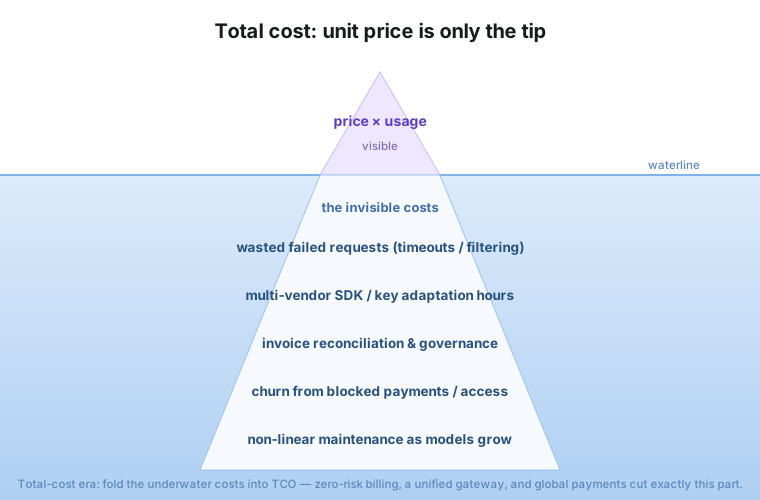
Variable 1 — Unit price is no longer the only variable
Under a total-cost lens, one call's real cost has at least four parts: price × usage, wasted failed requests, multi-vendor adaptation hours, and the hidden overhead of reconciliation and governance. The most underestimated is failure cost. In workflow automation, batch generation, and long-chain reasoning, timeouts and content filtering are inevitable; if failures are billed, exploration budget quietly drains away.
That's why "no charge for failures" moved from marketing line to hard metric. On 97AI.PRO, for example, failed generations cost $0 — you pay only for successful outputs. For teams running dozens to hundreds of experiments in a row, that zero-risk billing changes the psychology of A/B testing outright. Cheap unit price is a bonus; controllable failure is the safety net.
Variable 2 — The unified gateway is becoming the default architecture
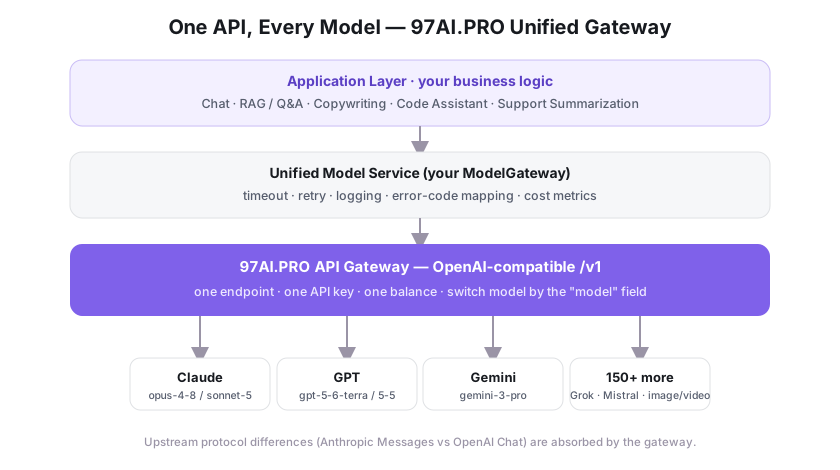
In the price-war era, teams wired up several official APIs by hand to save money. In the total-cost era, they do the math: scaling from 2 to 10+ models makes two SDKs, two keys, and two invoices grow non-linearly in tech debt and maintenance.
So the "unified gateway" shifts from option to default: the application keeps one OpenAI-compatible protocol and switches between Claude, GPT, and Gemini via a single model field, while vendor differences are absorbed by the gateway. Collapsing 150+ models into one API, one key, one balance (as 97AI.PRO does) pays off not by saving a few lines of code, but by turning "multi-model integration" — normally a repeated-rework chore — into sustainable infrastructure, shortening PoC-to-production.
Variable 3 — Global reach is the invisible gate
An underrated fact: not every problem is in the code. Many teams are blocked at payment and access — card-restricted regions (mainland China, LATAM, Eastern Europe), endpoints that need a VPN, English-only docs are all real drop-off points. In the total-cost era, payment methods and reachability stop being "extra features" and become preconditions for scaling.
That's why diverse payments (card, USDC, Alipay, WeChat), a low entry bar ($5 top-up), a 5-language UI (EN/中/ES/DE/JA), and direct China access without a VPN are becoming hard requirements when cross-border teams evaluate platforms. However strong the performance, if you can't pay or can't connect, on-the-ground value is discounted.
Variable 4 — Transparency is trust
Price wars compete on numbers; the total-cost era competes on verifiable promises. Public per-model comparisons (your price / official price / discount), explicit failure-refund rules, auditable bills — these "checkable" properties persuade more than "we're cheaper." Enterprise buyers verify line by line: interface unification, the discount band (~30–84%), whether failures are $0, whether payments and docs work end to end. Whoever survives that line-by-line check earns a spot on the shortlist.
Closing: the next infrastructure standard
The next round of competition among LLM platforms may not be about parameters and leaderboard scores, but about total delivery cost. Whoever integrates 150+ models, a unified API, global payments, and risk control into a genuinely usable, verifiable service gets closest to the next infrastructure standard.
For developers and enterprises, cheap matters — but stable, transparent, and verifiable is the precondition for long-term use. From that angle, an aggregator like 97AI.PRO deserves a place on the shortlist — but don't take the marketing at face value; run a real-workload load test and TCO accounting before you conclude.
In one line: the price war decides who gets in; the reliability war decides who stays. In the total-cost era, the winner is whoever makes the invisible costs transparent too.