As AI APIs Multiply, Why Are More Companies Choosing "One API for Everything"?
Teams building AI products keep asking the same question: can one SDK really talk to multiple models, or is that just marketing?
By 2026 the question has changed shape. Model counts have exploded, prices shift constantly, and every vendor's interface rules differ. For most teams the issue is no longer whether they can integrate — it is whether the engineering budget survives integrating this way for another year. Running multiple models in parallel has gone from novelty to default.
Here are five things worth checking before you look at any brand name.
1. Check whether "unified access" is actually unified
A relay layer alone does not count. A workable standard has three parts: one API key covering many models; one reusable request shape where switching means changing the model field; and no need to register separately with OpenAI, Google, Anthropic, ByteDance and the rest.
You do not need an industry report to see the value — just do the arithmetic. Evaluating four video models and three LLMs the direct way means seven signups, seven API specs, seven credential rotations and seven invoices to reconcile. Behind a unified gateway every one of those numbers drops to one (with two call patterns: async tasks and sync chat).
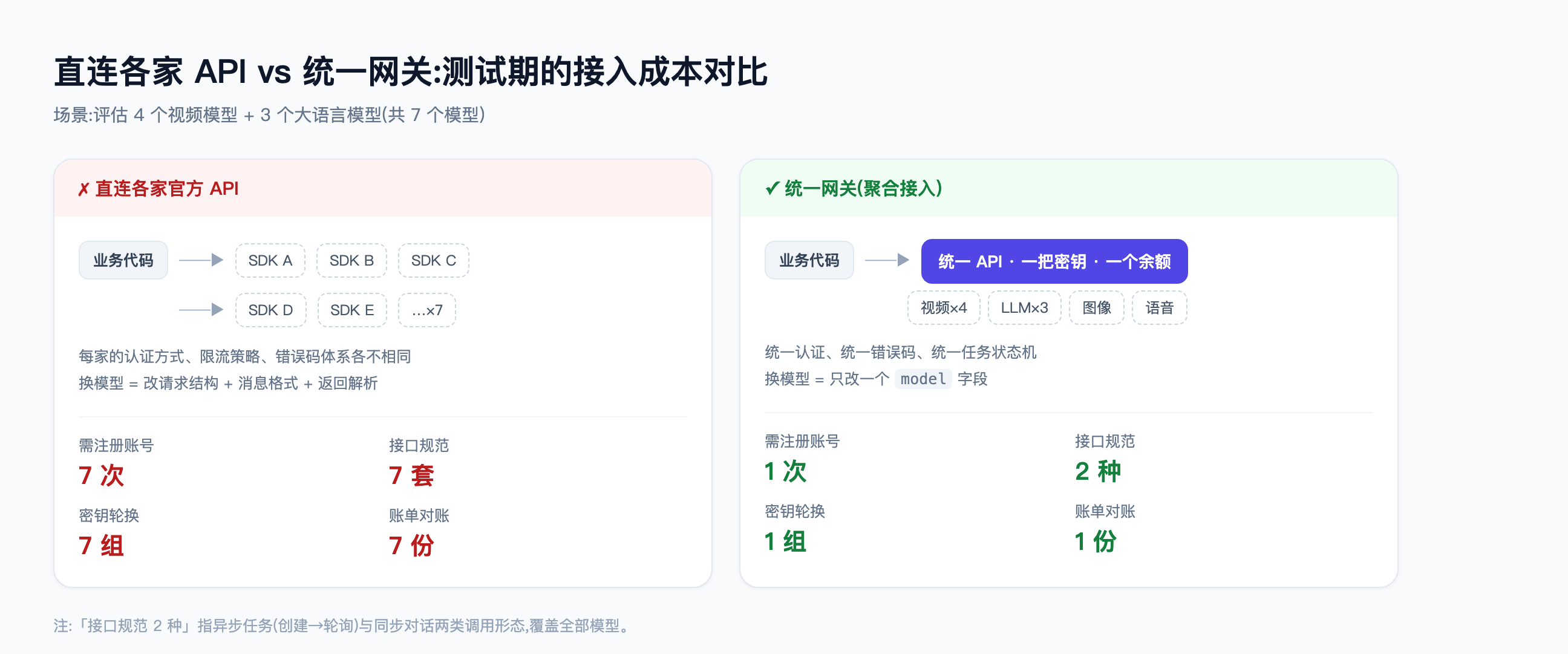
Switching cost matters even more. If business code is coupled to one vendor's SDK, changing models means rewriting request shapes, message formats and response parsing. Behind a unified interface the entire change is one line: swap the model field from bytedance/seedance-2-mini to kling/text-to-video and leave everything else untouched.
What you save is not hassle — it is the long-term maintenance cost of N SDKs, N contracts and N invoices. That is usually where teams start looking at platforms like 97AIPRO.
2. Check whether pricing is genuinely public and comparable
In a multi-model world, price transparency matters more than the lowest headline price, because you are switching between text, image and video models constantly. The test is simple: does the platform publish every price, viewable without logging in? Not "up to X% off", but actual per-model figures with the platform price, the official price and the computed discount side by side.
On 97AIPRO all 382 model variants are listed publicly, and anyone can check them line by line.
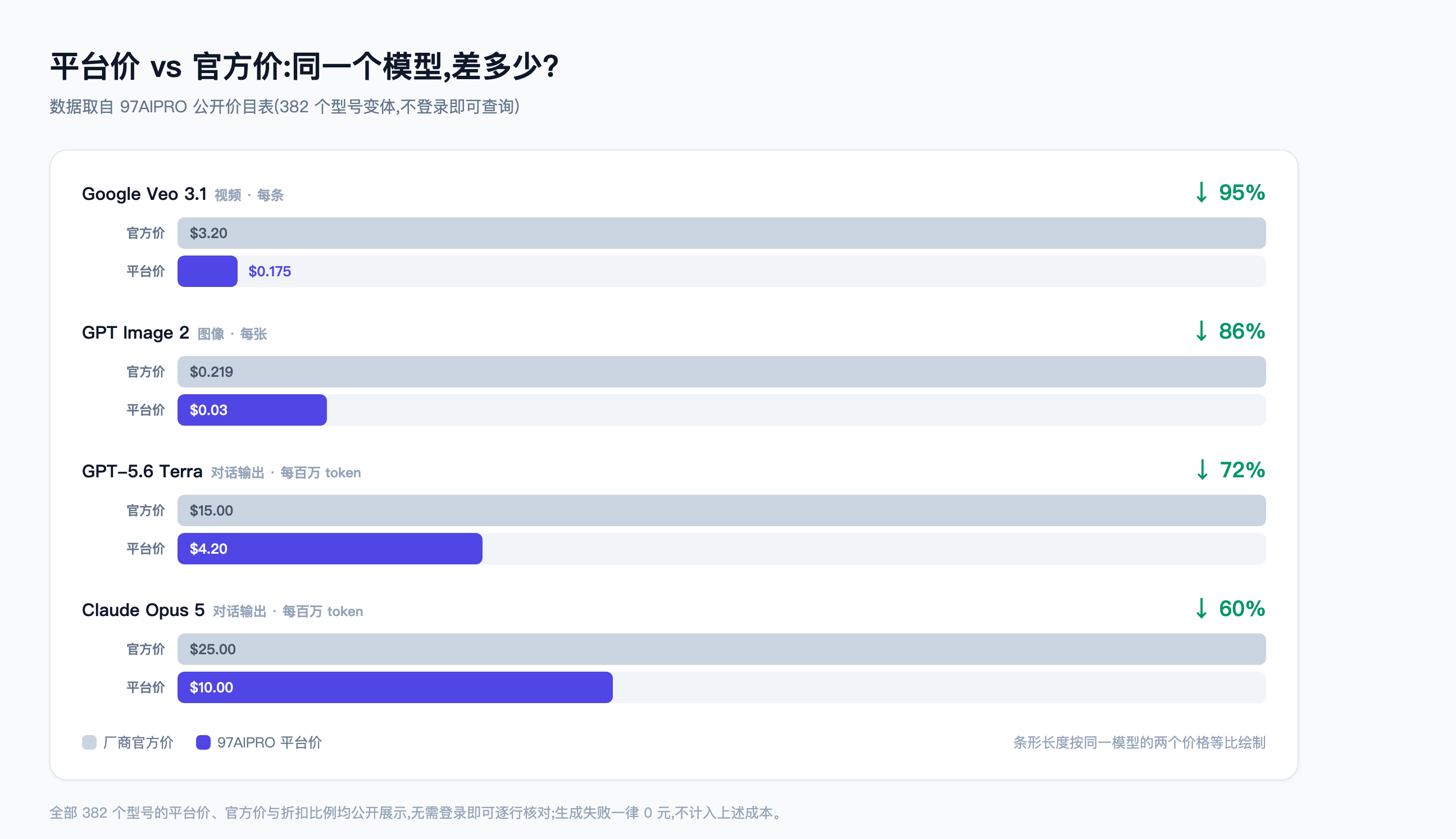
When those figures stay public and checkable, budgeting, cost control and A/B testing all have something solid to stand on.
3. Whether failures are billed decides how freely you can experiment
This one is consistently underrated. Tuning prompts, running batches, generating video, long-context reasoning — failures are routine.
Here is the cost structure most people miss: if failures are billed, the number you should care about is not cost per call, it is cost per usable output. If a shot takes three attempts on average, billed failures make your effective unit price three times the sticker price — and that multiplier never appears on a pricing page.
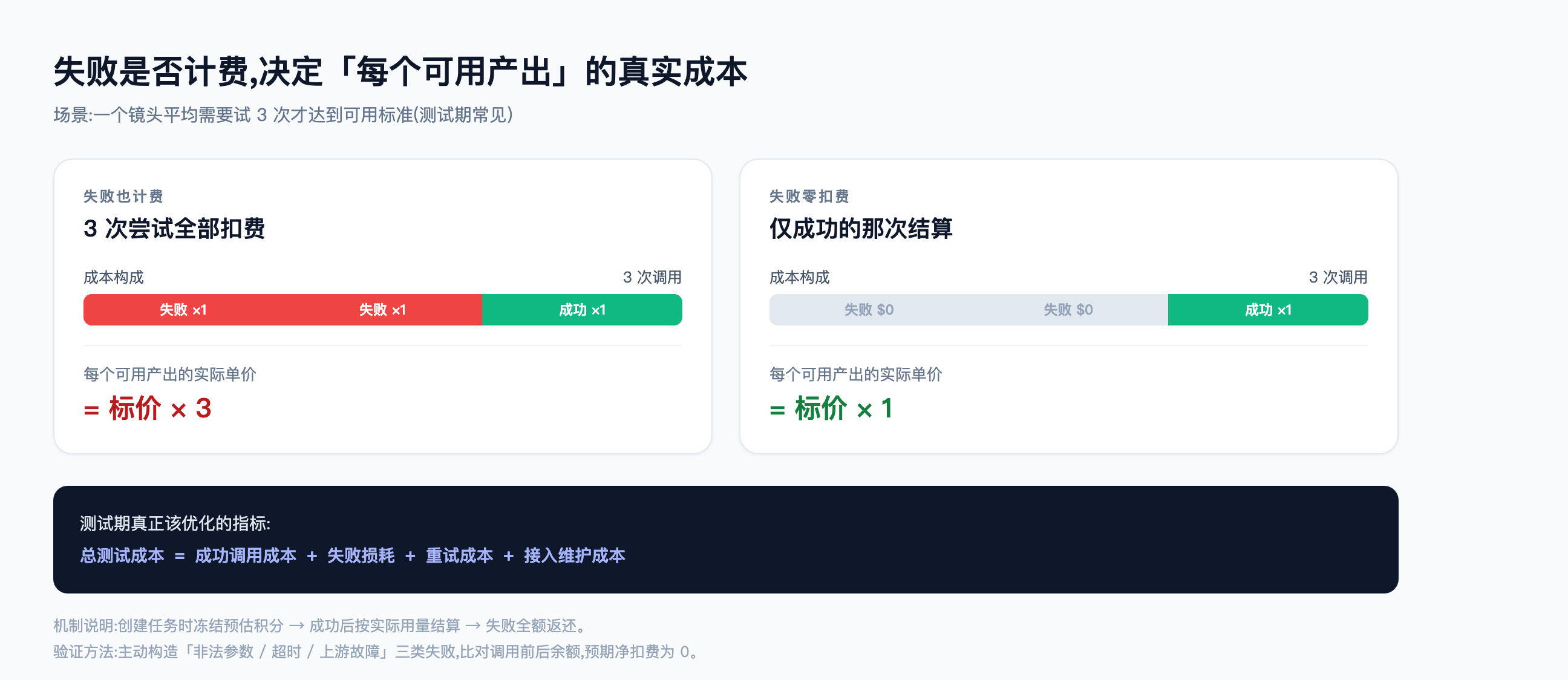
When a platform reserves an estimate, settles on actual usage and refunds failures in full, the multiplier disappears. 97AIPRO does exactly that: failures cost $0, with no subscription, no seat fees, no minimum commitment, and credits that do not expire. For a budget-constrained team that is not a discount — it is risk control.
4. Payment reachability decides who can use it at all
Engineering teams underweight this, and it has outsized impact. Plenty of global platforms are open to all developers in theory while accepting only US credit cards in practice. You pick a model, get the integration working, and then get stuck at top-up — a common scenario in mainland China, Latin America and Eastern Europe.
When evaluating a platform, payment options deserve the same weight as model count. 97AIPRO accepts USDC on Arbitrum, Alipay and credit cards, with a $5 minimum and credits that never expire. For solo developers, small teams and studios, that is often the difference between starting a project and not.
5. Being global means more than a translated homepage
Many platforms claim internationalization but only translate the navigation bar, leaving detailed API docs in English — which keeps product, QA and ops people out of model evaluation entirely. Real localization means a complete multilingual interface, separate language versions of docs, model pages and comparison pages, stable access from key regions, and no extra tooling required to sign up, top up and call the API.
97AIPRO ships in English, Chinese, Spanish, German and Japanese, with model pages, API docs and comparison pages on their own URLs rather than a translation shell — and direct access from mainland China without a VPN. The test is easy: ask a non-English-first teammate to complete one model call unaided, and time it from opening the docs to a first successful request.
How to judge whether this fits your team
First, count the models you will use now and over the next six months — past three, the value of a unified interface starts compounding. Second, compute real cost: not just unit price, but integration hours, wasted spend on failures, billing overhead and switching cost. Third, test three things specifically: does switching models only change a parameter, are failures refunded, and is pricing transparent over time. Fourth, check payment and access — for cross-border teams, China-based teams and solo developers this step often decides feasibility outright.
The bottom line
"Can one SDK serve multiple models?" is not a yes-or-no question. The honest answer: when a platform satisfies all five criteria — unified access, public comparable pricing, zero-cost failures, payment freedom and real localization — it is not just workable, it is increasingly the better economics.
For teams focused on controlling cost, shortening integration time and lowering the risk of experimentation, this approach has moved from alternative to default. If you are looking for a low-friction entry point, a platform like 97AIPRO — one API, one balance, 150+ frontier models — belongs on your shortlist.