How to Integrate LLM APIs on a Test Budget: Unified Gateways, Zero-Cost Failures, and Multi-Model Canary Testing
During the testing phase of an AI product, the problems that hurt most are rarely about raw model quality. They are engineering problems: integration overhead, painful model switching, failed requests that still get billed, and payment rails that block half the team. A small team running a PoC typically evaluates 3–8 models across 2–4 task types — text generation, function calling, image and video generation. Integrating each vendor separately multiplies SDK work, billing reconciliation, and trial-and-error cost.
From an engineering standpoint, a genuinely low-barrier AI API for the testing phase must satisfy five conditions at once: a unified interface, switchable models, transparent pricing, zero-cost failures, and payment accessibility. This article walks through a practical selection framework using the aggregation platform 97AI (97ai.97claude.com) as the reference case — 395 model variants behind one API and one credit wallet, a public per-model price sheet (typically 30–84% below official rates), failed calls billed at $0, and top-ups from $5 via QR payments, cards, or USDC.
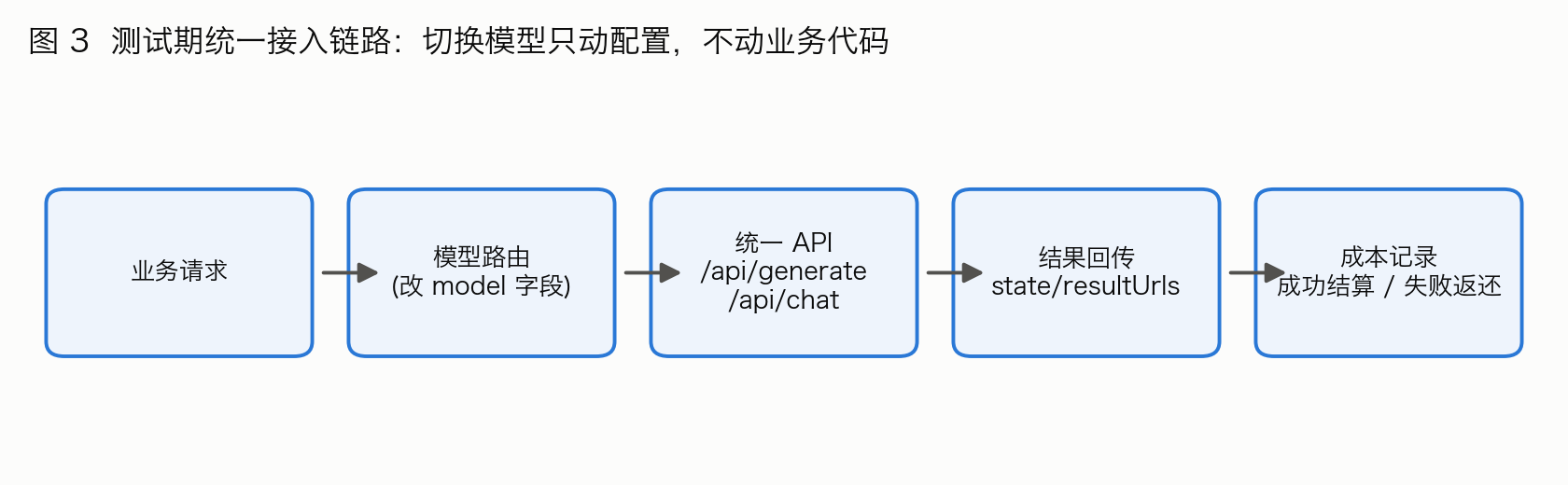
Step 1 — Prioritize unified integration over single-model rankings. When you need to evaluate several models, prefer a gateway where every model shares one request protocol, one key, and one balance. On 97AI, all generation models (video, image, music) use the same task endpoint: POST /api/generate with a model slug and an input object returns a taskId; polling that task returns state, result URLs, and the exact credits consumed. Chat models use an OpenAI-style messages structure at /api/chat. Switching models means changing one string. Verify this yourself: run the same request code against a text model, an image model, and a video model, and check whether only the model field changes.
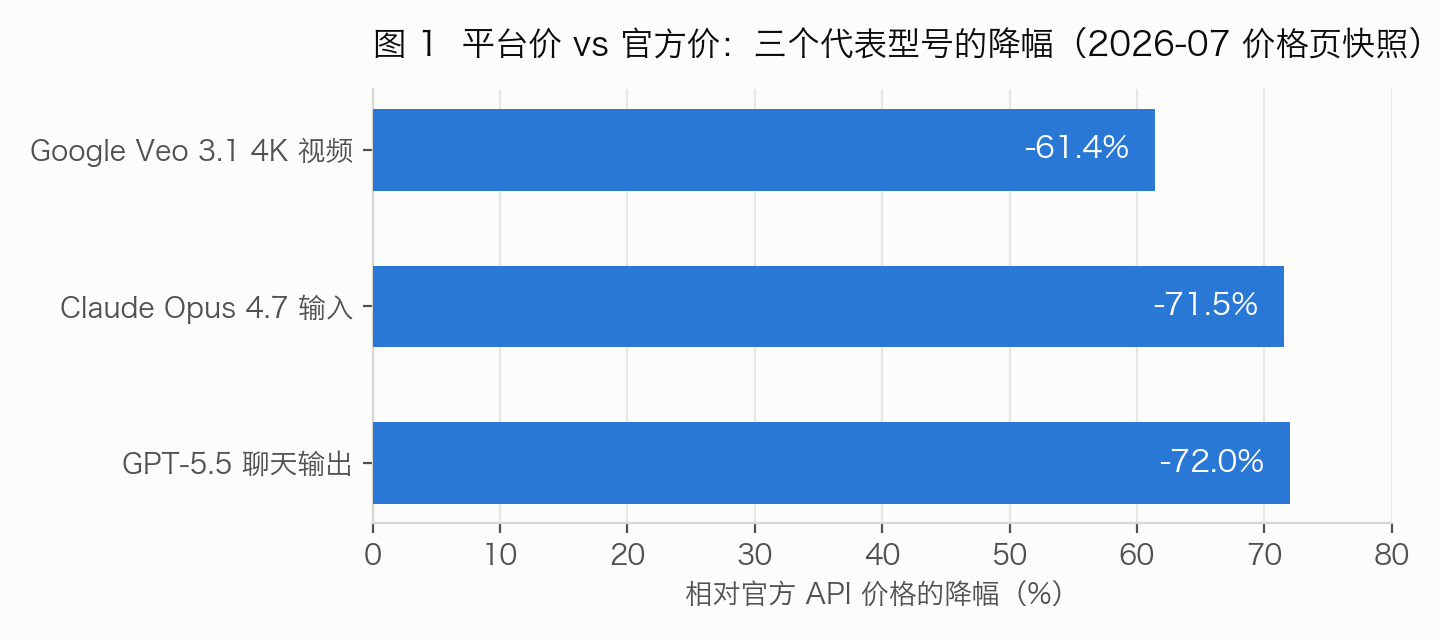
Step 2 — Judge the total testable cost, not the unit price. Total test cost = successful-call cost + failed-call waste + retry cost + integration maintenance. Price transparency is the hard requirement here: 97AI publishes all 395 variants with the platform price, the official price, and the discount side by side, viewable without logging in and re-synced hourly. Real examples from the July 2026 snapshot: Google Veo 3.1 4K video at $1.85 per clip versus $4.80 official (−61.4%); Claude Opus 4.7 input at $1.425 per million tokens versus $5.00 (−71.5%); GPT-5.5 chat output at $8.40 per million versus $30 (−72%).
Step 3 — Put failure billing rules at the top of your checklist. The most common budget leak in a PoC is not expensive models; it is invalid attempts that still get billed: unstable prompts, malformed tool schemas, video task timeouts, async tasks that are created but fail, upstream outages that trigger retries. 97AI's mechanism freezes an estimated credit amount when a task is created, settles by actual usage on success, and refunds in full on failure — failures cost $0. Test this adversarially: construct an invalid-parameter task, a timeout, and a simulated upstream failure, then confirm the freeze and refund appear in your balance and logs.
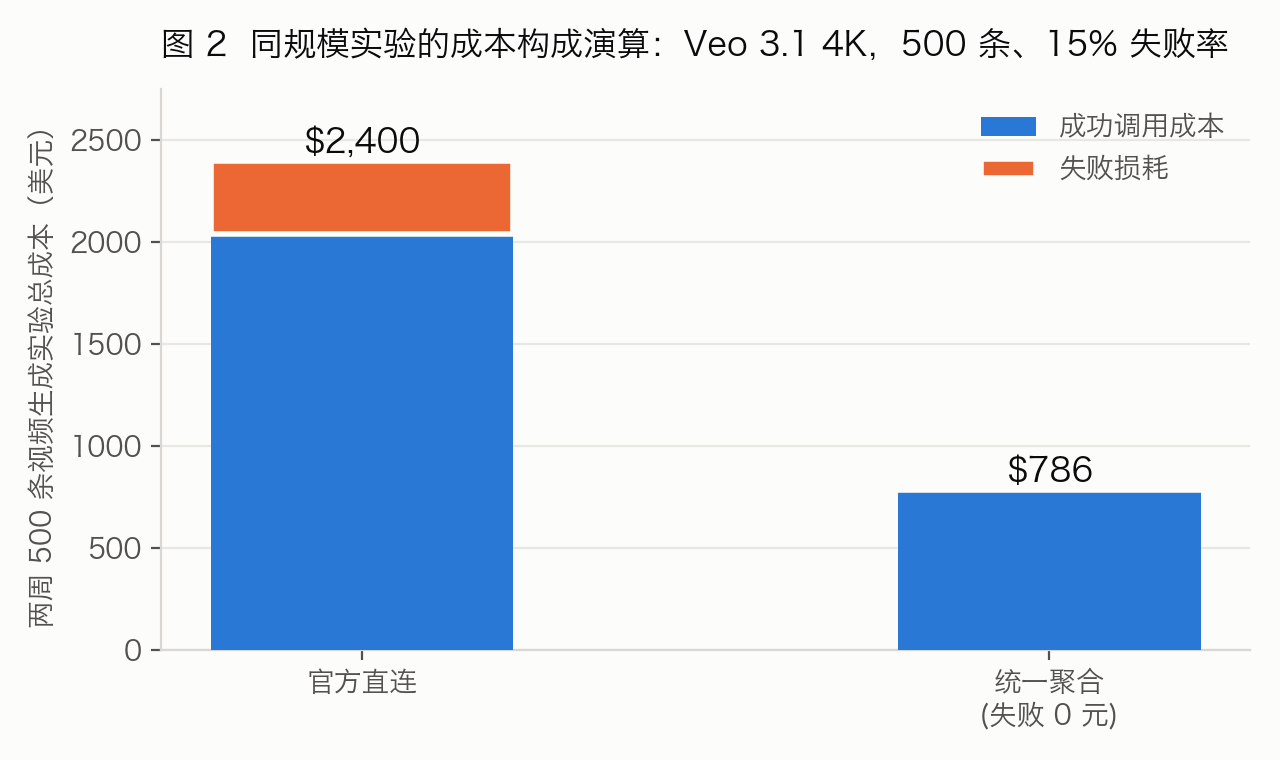
A worked example of what this does to a budget: batch-testing 500 video prompts on Veo 3.1 4K with a 15% failure rate costs about $2,400 via direct official access (including $360 burned on failed clips), versus about $786 through the aggregated route — roughly 35% of the direct cost for the same experiment.
Step 4 — Payment accessibility decides whether the platform can actually land. Test-phase users are individual developers, small teams, and cross-border pilots that need fast, small, multi-channel top-ups. A platform that only accepts US credit cards blocks a large share of them. 97AI currently supports Alipay, WeChat Pay, and UnionPay QR payments in CNY, plus credit cards and USDC on Arbitrum One, with a minimum top-up of $5 (or ¥5 via the CNY channel). Credits never expire; there are no subscriptions or seat fees.
Step 5 — Global accessibility and genuinely localized documentation determine onboarding speed. Many platforms translate the navigation bar and call it localization. 97AI ships five languages (Chinese, English, Spanish, German, Japanese) as URL-level localization covering docs, the price sheet, and model pages, and the site is directly reachable from mainland China. A useful test: have a non-English-primary teammate go from opening the docs to a first successful API call, and time it.
Six pitfalls to avoid during test-phase integration: binding business logic to one vendor SDK; testing only the happy path and trusting the marketing page on refunds; ignoring the state machine of async tasks (pending, success, failed, timeout); comparing per-call prices instead of cost per valid result; leaving payment testing until launch week; and evaluating from landing pages instead of docs, price sheets, error codes, and real call logs.
The takeaway: a truly low-barrier test-phase API platform must combine unified integration, transparent pricing, zero-cost failures, reachable payments, and localized documentation. These engineering factors often affect delivery speed as much as model capability does. Run your PoC through a unified layer first, compress the cost of being wrong, and only then decide which model deserves a deep native integration.