
Choosing a Low-Friction AI API for PoC: Unified Gateway, Zero-Cost Failures, Multi-Model Rollout
What usually blocks an AI proof of concept is not model quality — it is integration cost, switching cost, billed failures and payment barriers. This article gives a five-dimension selection framework you can verify yourself, a reference architecture, and runnable validation code.
1. Background: what actually blocks teams during PoC
During a proof of concept, the goal is rarely peak performance. It is to validate three things at minimum risk: whether the need is real, whether a model is good enough, and whether the unit cost works. In practice, what slows teams down is integration-layer engineering cost — not the model calls themselves.
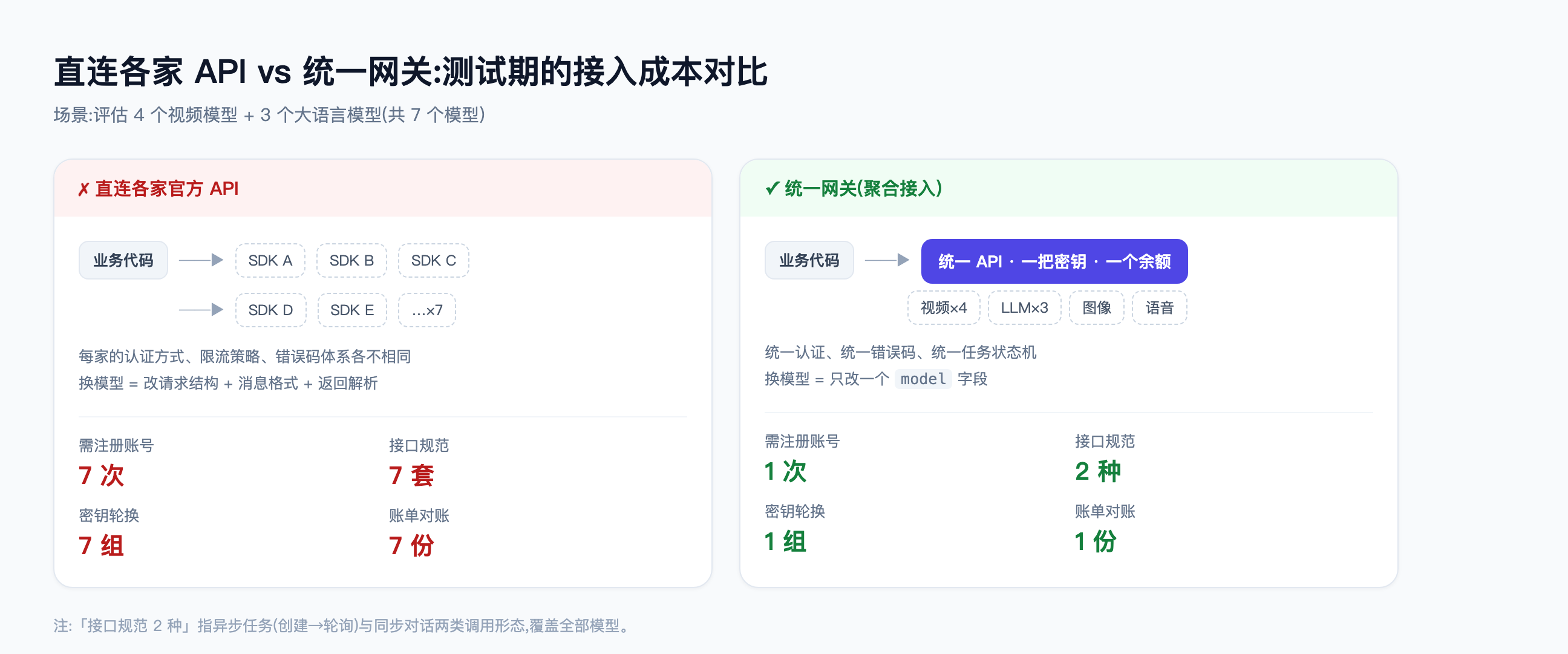
Four problems come up repeatedly. First, repeated integration work: every vendor has its own auth scheme, SDK, rate-limit policy and error taxonomy, so evaluating four video models and three LLMs means seven signups, seven API specs, seven credential rotations and seven invoices to reconcile. Second, expensive switching: if business code is coupled to one vendor's SDK, changing models means rewriting request shapes, message formats and response parsing. Third, billed failures: PoC work is iterative by nature, and if timeouts, bad parameters and upstream faults all cost money, teams quietly reduce how much they test. Fourth, payment barriers: most platforms only accept Western bank cards, which locks out developers in mainland China, Latin America and Eastern Europe.
What these share is that none of them is a model-quality problem. They are governance problems. Choosing a platform for the PoC phase is really choosing an integration governance strategy.
2. A five-dimension selection framework
Each step below comes with a way to verify it yourself, so you never have to take marketing claims at face value.
Step 1 — Judge unified access first, not single-model rankings
If you need to evaluate three to eight models, prefer a unified gateway: many models behind one request protocol, one key and one balance, where switching means changing the model field. Integration complexity drops from N SDKs to one, and billing from N invoices to one.
How to verify: call a text model, an image model and a video model with the same code and see whether only the model field and a few parameters change. Check that error codes, rate-limit signals and headers are consistent. Note that platforms advertising "OpenAI-compatible" often diverge on tool calling, streaming and async task polling — test those three specifically.
Step 2 — Model total test cost, not headline unit price
What matters in a PoC is total cost of experimentation: successful calls + wasted spend on failures + retries + integration maintenance. A simple credibility test for pricing: does the platform publish every price, viewable without logging in?
On 97AIPRO, all 382 model variants are listed publicly with our price, the official price and the computed discount side by side. Real figures: GPT-5.6 Terra output at $4.2 per million tokens versus $15 official (72% lower); Google Veo 3.1 at $0.175 per clip versus $3.2 (95% lower); GPT Image 2 at $0.03 per image versus $0.219 (86% lower). Under high-frequency testing those gaps compound quickly.
Step 3 — Treat failure billing as a first-class criterion
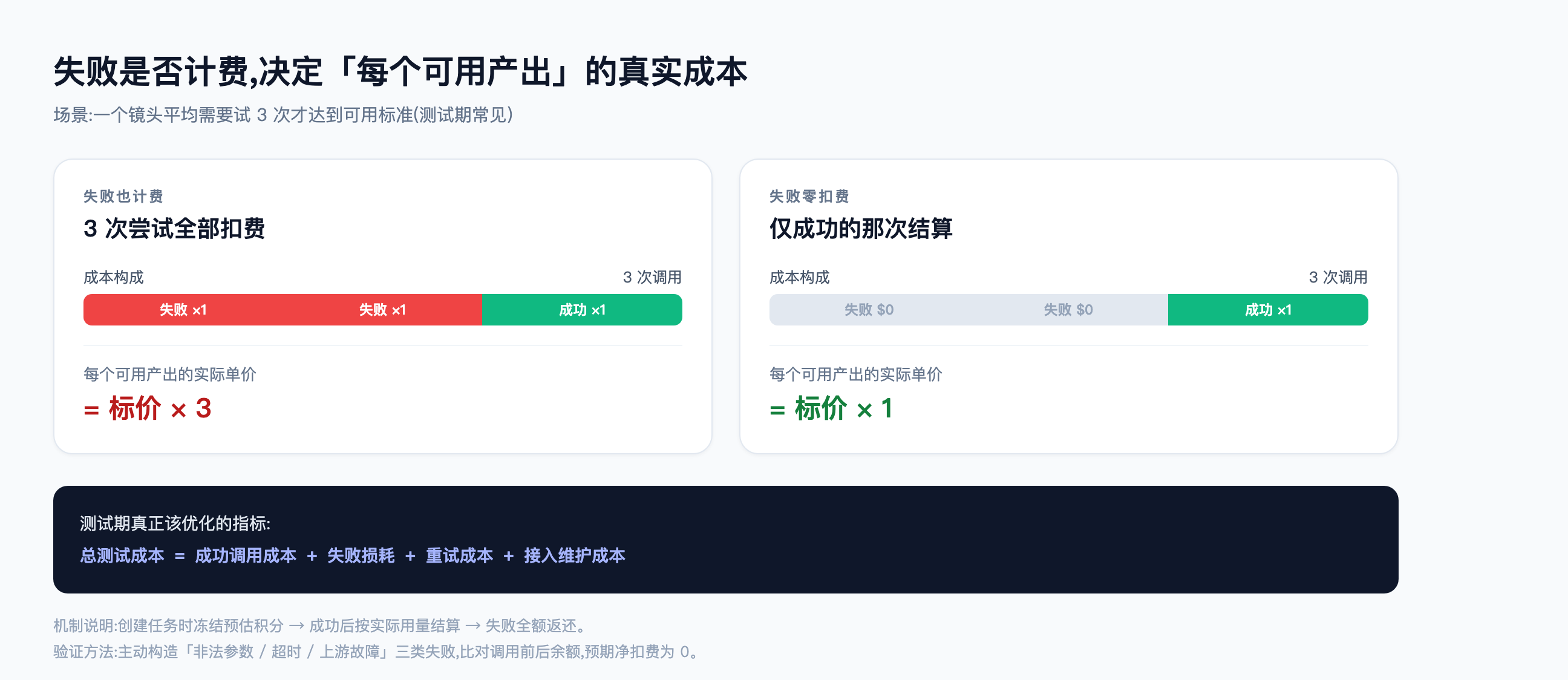
The most common waste in a PoC is not that models are expensive, but that invalid attempts get billed: unstable prompts, malformed tool-call schemas, video timeouts, async tasks that are created successfully but fail during generation, upstream outages that trigger retries.
There is a cost-structure point that is easy to miss. If failures are billed, the number you should care about is not cost per call but cost per usable output. If a shot takes three attempts on average, billed failures make your effective unit price three times the sticker price. When the platform only reserves an estimate, settles on actual usage and refunds failures in full, that multiplier disappears.
How to verify: deliberately construct three failure classes (timeout, invalid parameters, simulated upstream fault) and check that reservations and refunds are prompt and auditable. For async work, specifically test the "created successfully, failed during execution" case. Ask explicitly how a mid-stream interruption is billed.
Step 4 — Payment reachability decides whether the platform is usable at all
Engineering teams underweight this, and it has outsized impact. You pick a model, get the integration working, and then get stuck at top-up. Card restrictions are common in mainland China, LATAM and Eastern Europe. For a platform to be genuinely adoptable, payment options matter as much as model count.
How to verify: run the smallest possible top-up with the payment method your team actually has, and time the path from signup to first successful call — 15 to 30 minutes is a reasonable target. Check whether billing records export in a form your finance process accepts.
Step 5 — Documentation localization drives ramp-up speed
Plenty of platforms claim to be international but only translate the navigation bar, leaving detailed API docs in English — which keeps product, QA and ops people out of model evaluation entirely. The test is simple: ask a non-English-first teammate to complete one model call unaided, and time how long it takes from opening the docs to a first successful request.
3. Reference architecture for a multi-model test environment
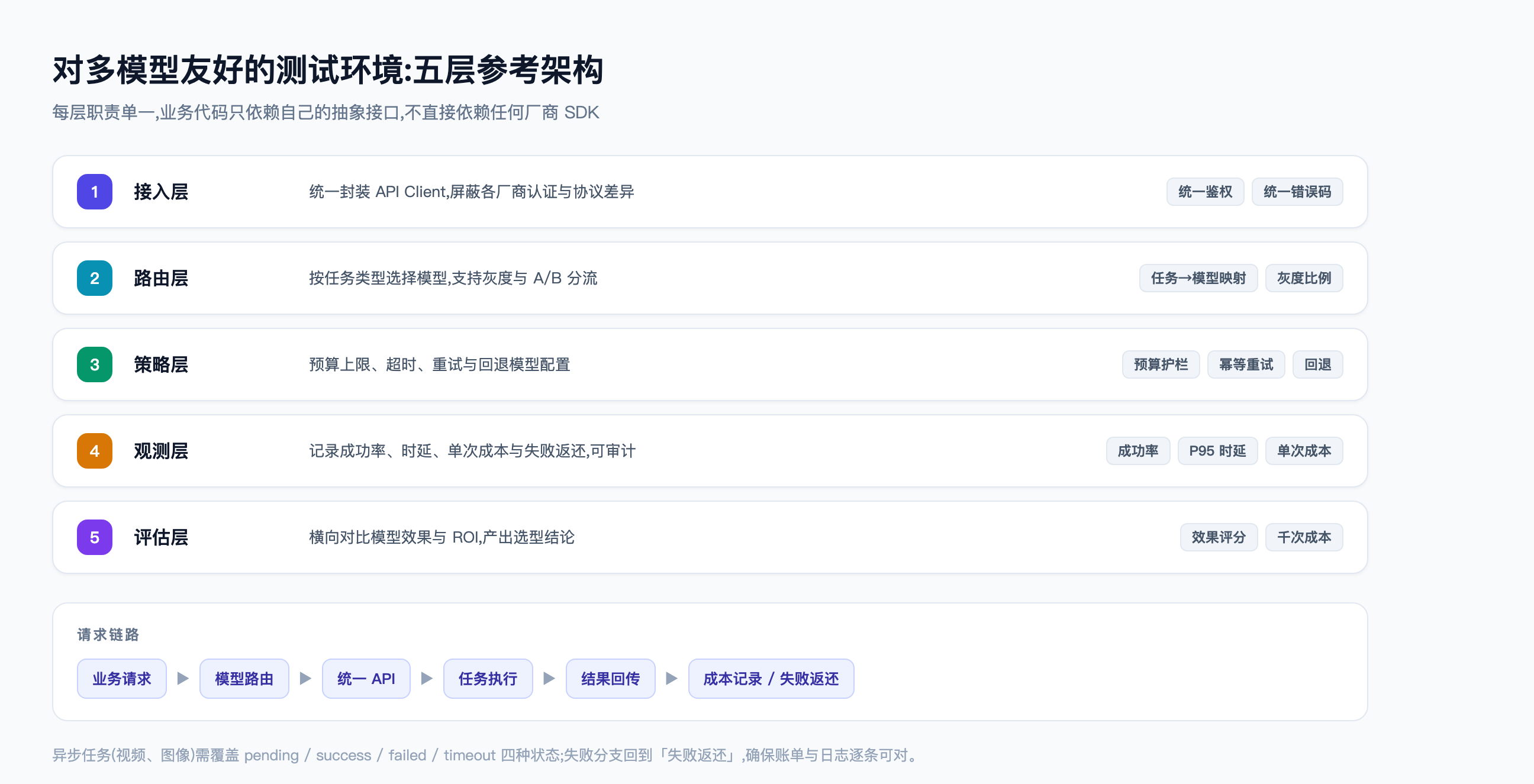
For a test environment you can keep using, five layers with single responsibilities work well:
An access layer wrapping a unified API client that hides vendor differences; a routing layer that picks a model per task type; a policy layer holding budget caps, timeouts, retries and fallbacks; an observability layer recording success rate, latency, per-call cost and refunds; and an evaluation layer comparing model quality and ROI.
The key design rule is to keep a vendor abstraction layer separate from business code. Business logic depends only on your own interface, never directly on a vendor SDK — so future model or platform changes stay contained inside the abstraction.
4. Five steps to validate a platform
Step 1 — Define goals and budget first
Decide whether this round validates quality, stability or cost, and fix four metrics: success rate, average latency, cost per call and refund ratio on failures. A workable scale is 1,000 text calls, 200 image tasks and 50 video tasks, with a hard budget cap.
Step 2 — Build a minimal integration against the unified interface
Write a small client that implements only generic fields; do not hard-code vendor-specific parameters on day one. Two call patterns on 97AIPRO cover every model — async create-then-poll for media, and a single synchronous call for chat:
import requests, time

API = "https://97ai.97claude.com"
KEY = "sk-live-YOUR_KEY"
H = {"Authorization": f"Bearer {KEY}"}

# Synchronous: chat models return text in one call
r = requests.post(f"{API}/api/chat", headers=H, json={
    "model": "chat/claude-sonnet-5",
    "messages": [{"role": "user", "content": "Explain vector databases in three sentences"}],
})
print(r.json()["text"])

# Asynchronous: image/video — create a task, then poll
r = requests.post(f"{API}/api/generate", headers=H, json={
    "model": "bytedance/seedance-2-mini",
    "input": {"prompt": "slow push-in, natural light", "resolution": "720p"},
})
tid = r.json()["taskId"]
while True:
    j = requests.get(f"{API}/api/generate/{tid}", headers=H).json()
    if j["state"] in ("success", "fail"):
        break
    time.sleep(4)
print(j.get("resultUrls"), j.get("creditsConsumed"))
The check: swap model for a different one and confirm the surrounding logic needs no changes. That is the most direct test of what a unified gateway is worth.
Step 3 — Force failures and verify refunds
Always exercise the failure path during a PoC rather than only the happy path. Construct at least three classes: invalid parameters, timeouts and upstream faults.
# Force failures, then reconcile reservations and refunds
cases = [
    ("invalid params", {"model": "kling/text-to-video", "input": {"prompt": "x"}}),  # missing required fields
    ("bad asset",      {"model": "bytedance/seedance-2-mini",
                        "input": {"prompt": "test", "first_frame_url": "https://invalid.example/x.jpg"}}),
]
before = requests.get(f"{API}/api/credits", headers=H).json()["credits"]
for name, payload in cases:
    r = requests.post(f"{API}/api/generate", headers=H, json=payload)
    print(name, r.status_code, r.text[:120])
after = requests.get(f"{API}/api/credits", headers=H).json()["credits"]
print("net charge for failed tasks:", before - after, "(expected 0)")
The check: failures refund in full, refunds land promptly, and logs reconcile against billing line by line. For async tasks, pay particular attention to the created-then-failed case.
Step 4 — Build a model comparison table
Compare models under one prompt set, one test corpus and one budget cap. Useful columns: model name, unit price, average latency, success rate, subjective quality score, cost per 1,000 requests, and refund policy. Aim to identify two models — the best-quality one and the best value one; the latter often makes a good fallback.
Step 5 — Validate payment and collaboration
If top-ups, shared balances and multi-member collaboration are painful, the platform will not survive a PoC. Verify that the first top-up completes, that the team can share keys and budget, and that billing exports well enough for a retro. 97AIPRO accepts USDC on Arbitrum, Alipay and credit cards, with a $5 minimum and credits that do not expire.
One practical engineering detail: API keys can be scoped to specific models, enforced at the relay with a 403 for anything outside the allow-list. Issuing differently scoped keys per sub-team during a PoC keeps budgets from cannibalising each other.
5. Six pitfalls worth avoiding
Do not couple business logic directly to a vendor SDK — it multiplies refactoring cost later. Do not test only the happy path; refund behaviour must be measured. Do not neglect the state machine for async image and video tasks; cover pending, success, failed and timeout at minimum. Do not compare headline prices; compare cost per usable result. Do not leave payment testing until just before launch — a failed top-up blocks everything. Do not rely on marketing pages; evaluate docs, price tables, error codes and real call logs together.
For engineering conventions, RFC 9110 (HTTP semantics, useful for designing idempotent retries) and the OWASP API Security Top 10 (key management and interface hardening) are both public, citable references.
6. Conclusion
For the PoC phase, a genuinely low-friction AI API platform has to satisfy five conditions at once: unified access, transparent pricing, zero-cost failures, reachable payment, and localized documentation. Their impact on delivery speed is often comparable to differences between the models themselves.
If the goal is to finish a PoC quickly, run multi-model rollouts and cap the cost of experimentation, a unified aggregation entry point usually fits better: validate on one platform first, compress the cost of trial and error, and only then decide whether to bind deeply to a specific vendor. That progressive path is safer than betting on a single provider up front.